'Liquid blanket' drops solar panel DC voltage to zero
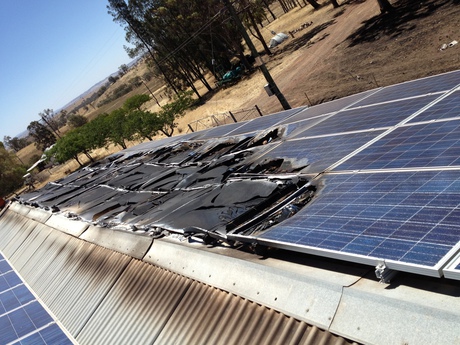
Solar panels cannot be turned off when exposed to light and can potentially cause electrocution during an emergency situation. In the event of a short circuit or an emergency such as a fire or flood, they continue to produce a potentially lethal amount of DC voltage.
To address this issue, Australian company LJW Solar has developed PVStop — a spray-on solution to mitigate solar panel risks by reducing DC output to safe levels.
The technology is designed to safely deactivate photovoltaic panels in all weather conditions in seconds, mitigating the risk of DC electrocution to emergency services personnel, electrical contractors and all owners of solar panel systems.The ‘liquid blanket’ covers the solar panel and blocks the light from reaching the solar panel surface. The neutralisation process takes less than three seconds; to completely disable the solar panel can take as little as six seconds.
The PV module does not need to be entirely covered for the panel to be deactivated. Spraying a line down the middle of the panel, for example, and covering only as much as 25% is enough to interrupt solar power production.
Luke Williams is a CEC (Clean Energy Council) accredited renewable energy system designer at LJW Solar and also the inventor and patent holder of PVStop. He has worked in the solar industry since the early eighties, designing and installing solar photovoltaic and wind energy systems for a variety of domestic and commercial clients.
“Over the years, LJW Solar has become increasingly concerned about solar panel risks and associated solar PV hazards,” said Williams. “With over 1 billion solar panels installed globally and 1.5 million solar panel installations in Australia alone, the need for a solution to combat the risk of DC electrocution in the face of an emergency situation has become paramount; this is the driving reason behind why we developed PVStop.”
PVStop is a polymer film technology that literally acts as a ‘liquid blanket’, switching off the solar panels in seconds and reducing the risks faced by emergency services personnel, electrical contractors and all owners of solar panel systems. Once the threat has been eliminated, the film can be simply peeled off the solar panel within up to 12 months after application.
Phone: 02 9652 5000
Milwaukee Tool M18 REDLITHIUM HIGH OUTPUT XC5 batteries
Milwaukee Tool has upgraded its M18 system by enhancing the M18 REDLITHIUM 5.0AH battery.
Legrand INSPYRA switch and socket range
Combining a sleek aesthetic with practical functionality, the range is designed for...
Adept Direct Cable Drum Channels
Built to accommodate cable reels up to 1000 kg in weight and 1000 mm in width, these channels...