Redesigning energy: can the grid adapt to significant change?

Whether you’re an electrical worker, a renewable energy proponent, a data centre operator or someone who works with energy technology, this is an interesting time for Australia’s grid, to say the least.
Just as renewables are truly beginning to pull their weight, 225 proposed data centres loom on the horizon. Will they overburden the grid, set back Australia’s climate goals and siphon off talent from an under-resourced electrical sector that’s sorely needed for housing construction? Or will they boost the electrical workforce through training, contribute electricity to the grid and be a catalyst for the creation of more renewable power assets? Time will tell.
To further complicate this picture, various ambitious transmission projects are being held up by community opposition, and climate change continues to produce the kind of extreme weather that strains energy supply.
As uncertainty prevails, here’s a rundown of the main challenges faced by Australia’s grid.
Data centres

According to the Australian Energy Market Operator’s (AEMO) 2026 Electricity Statement of Opportunities report, data centre electricity consumption in the National Electricity Market (NEM) is predicted to increase from about 5 TWh in 2025–26 to 34 TWh by 2035–36, rising from approximately 3% to 13% of electricity supplied through the grid.
In anticipation of a data centre boom, various organisations are trying to ensure that these massive pieces of infrastructure operate in a way that contributes to Australian society without stripping the nation’s precious resources. The Australian Energy Market Commission (AEMC) has submitted four suggested reforms to the government, stipulating that data centres provide their own clean energy; prove their demand is backed by new firm capacity, so their connection doesn’t tip the supply–demand balance and push up wholesale prices for everyone else; become registered market participants; and ease pressure on the network through flexible connection agreements.
In a move that places it ahead of the curve, the South Australian Government has announced a Royal Commission into Artificial Intelligence that is expected to commence on 1 October, with a final report to be handed to government no later than 1 July 2027. Included in its terms of reference are “opportunities related to AI-related infrastructure including the interrelationship with energy transformation, water usage and associated impacts (such as electricity grid implications)”.
Dr Mehdi Ghazavi Dozein, from Monash University’s Low-Carbon Energy Lab, Department of Electrical and Computer Systems Engineering, believes Australia is well placed to support the growth of AI-driven data centres, but success will depend on establishing the right technical and regulatory frameworks for grid connection and operation.
Via a research partnership with AusNet Services, Dozein and his colleagues have been investigating how data centres behave under both steady-state and transient conditions.
“We use advanced modelling to understand how large loads, including large data centres, interact with the electricity system, how their demand changes over time, and what that means for reliable and stable grid operation,” Dozein said.
“This includes how they respond during power system disturbances and what is needed to ensure reliable grid connection and operation, with the focus on modelling framework development, grid-code compliance analysis, and system level impact studies.”
Dozein emphasised that data centres are fundamentally large electricity loads, not generation assets. “That distinction matters for how we plan, connect and operate them within the electricity system.”
Ambitious transmission infrastructure
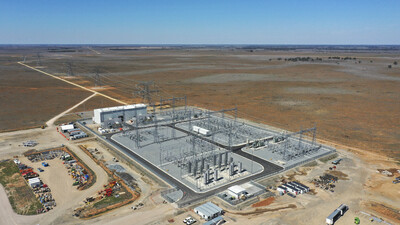
As coal-fired power stations retire, the move to integrate renewables into the nation’s grid has seen some impressive transmission projects come to fruition. For example, construction and initial energisation are now complete on Transgrid’s massive EnergyConnect project, which is expected to be integrated into the NEM by the end of 2026. The 900 km project connects the New South Wales, Victorian and South Australian grids for the first time, providing a means for solar, wind and other renewable energy to be plugged in as coal is phased out.
VNI West, the high-voltage, double-circuit overhead transmission line connecting NSW and Victoria, is not faring so well. Though identified as a priority project in AEMO’s 2026 Integrated System Plan, VNI West has been held back by community opposition for several years, with Victorian landholders refusing access to their properties and some local governments formally opposing the project (eg, Buloke, Northern Grampians and Gannawarra Shire Councils in regional Victoria).
Community submissions protesting the NSW section of VNI West have criticised the utility for a lack of consultation with the community and landholders, as well as rushed, one-directional consultation which lacked transparency, among other perceived failures.1 In Victoria, politicisation of the energy debate is a clear factor in anti-VNI West sentiment, with renewable options characterised in some sections of the media and politics as left-wing and anti-rural.
In contrast, another one of AEMO’s priority projects, Project Marinus — the planned interconnector running between Tasmania and Victoria — has cleared its various approvals and is on track to start construction this year. Delivered by Marinus Link Pty Ltd, the project will enable the two states to pair Victoria’s wind and solar with Tasmania’s flexible hydropower system and geographically diverse wind. Maybe the fact that it largely runs undersea has limited community opposition…
Workforce shortages
All this grid transformation requires a skilled workforce, both now and into the future. We’re facing a shortfall of 42,500 electricians by 2030, according to energy training advocacy group Powering Skills Organisation (PSO)2, many of whom will be needed to work in the energy field. Electricians account for around seven in every 10 energy trades workers, PSO has found.
In its August 2026 Electrician Workforce Capacity Study, PSO identified clear structural issues in the systems that currently exist to train electrical apprentices. While surveys consistently demonstrate there is no shortage of candidates who wish to become electricians3, there is a striking lack of positions available for these would-be apprentices.
Apprenticeship pathways are limited: the majority of energy apprentices (59%) are employed by electrical contractors, followed by Group Training Organisations (GTOs) at 7%. This is a problem if you want to grow the electrical workforce, for a couple of reasons. Firstly, electrical apprentices need to be trained and supervised by licensed electricians. The latter are concentrated in the small to medium electrical contracting sector (56%), with the others dispersed across a wide range of industries. All of this indicates that the future electrical workforce is largely dependent on the relatively small private electrical sector.
But while electrical contractors train 71% of all electrical apprentices, only 1 in 3 currently employs an apprentice. Since apprentices need to be supervised by a licensed electrician who could be engaged in other work, it’s not hard to see why apprenticeships might represent a financial loss for electrical contractors.
The PSO report’s purpose is to collect data rather than pushing future policy settings. However, it does suggest various measures that could make it more attractive for the contracting sector to train apprentices, including procurement settings, industry partnerships, tax measures, and training and innovation funds.
It’s not all up to the contracting sector to solve the workforce shortage problem, though, and the report emphasises that addressing the challenge will require a coordinated response across the training and employment ecosystem.
Extreme weather
With CSIRO projecting a continued increase in the number of dangerous fire weather days and a longer fire season for much of southern and eastern Australia4, climate-proofing the grid is an ongoing challenge. In its State of the Climate 2024 report, the national science body also recorded an intensification of heavy rainfall.
While extreme weather might be intensifying, it’s not a new issue, and utilities have been combating it through a range of technologies, including powerline drone inspections for bushfire preparation, remote smart monitoring of line faults, covered conductor for high-voltage powerlines, and strategically placed reclosers. Digital twins, geospatial mapping and AI have also helped to model natural disaster scenarios for energy companies, informing their response during real-world emergencies.
No easy solution
The challenges are formidable, but they also represent opportunities for significant growth and innovation within the electrical sector. Whether these opportunities are realised will hinge on research, government policy, funding and — in the case of major infrastructure — getting communities onside.
1. Victoria to New South Wales Interconnector West (VNI West) NSW | Submissions Report | 184
2. Based on Powering Skills Organisation’s analysis of data from Jobs and Skills Australia.
3. Electrician is the most preferred trade pathway among Australian high school students and the highest-ranked vocational career overall, according to PSO’s 2026 Electrician Workforce Capacity Study. It ranks in the top 10 for all students across various states, including New South Wales, Queensland, Western Australia and South Australia. For males in high school across the country, it ranks as the third most common career choice.
4. CSIRO State of the Climate 2024 report
This article has been updated to reflect the latest figures on data centres published in AEMO’s 2026 Electricity Statement of Opportunities report.
Reducing electrical injuries in Australian workplaces
Monash research has highlighted a need for better electrical hazards training across a range of...
Electrical infrastructure for Sydney's expanding Metro
Fuji SMBE Macquarie has delivered Australian-made switchboards and power infrastructure to six...
A close look at arc flash risk in hyperscale data centres
Schneider Electric has released a study assessing arc flash risk in 800 VDC power architectures,...