Pilot program supports women into electrical careers
An Australian pilot program is boosting female sparkies, along with women in other male-dominated industries.
The program, ‘She Means’, is administered by the Council of Small Business Organisations Australia (COSBOA) in partnership with Akin Agency, with funding from the Australian Government’s Advancing Gender Equality in Gender Segregated Industries grant program. It’s focused on the information and communications technology, financial services and energy sectors, with the aim of increasing female participation, retention and career progression in industries where women make up less than 30% of the workforce.
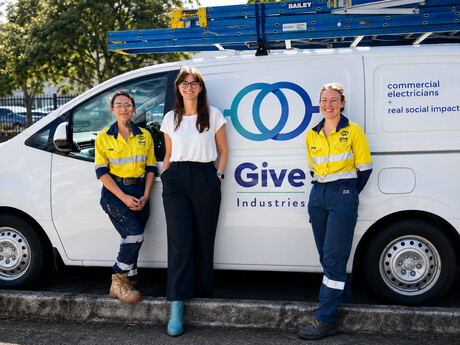
Thirty small businesses from across New South Wales, Queensland and Victoria took part in the program. Among them was Brisbane social enterprise Give Industries, an electrical contracting business that donates 100% of its profits to charities working to reduce extreme poverty and support communities affected by climate change.
Kat Dekker founded Give Industries with her partner Calvin Baker and their friend Jeremy Chirpaz, building the business around creating positive social impact.
Dekker said the funding from She Means allowed the business to invest in two of its tradeswomen — former chef Alisha Hadwin and Mary Thatcher, a mechanical engineer who worked in the mines — at an important stage in their careers.
“We’ve been philosophically aligned with the She Means goals for some time,” Dekker said. “We’ve already been trying to do things to incorporate women in trade and to make that pathway as seamless as possible.
“Because of where our two tradeswomen were at in their careers at the time the grant arrived, we were able to really focus in on that early training and confidence-building.”
Thanks to She Means, Hadwin and Thatcher were able to upskill in a solar and battery training program.
“I like when you like fly into Brisbane at night-time, all of those lights that you can see an electrician has been there,” Thatcher said.
The 34-year-old, who has worked in three Queensland coal mines, said training in solar and batteries presented its own challenges.
“Some batteries are pretty heavy, like 79 kilos, so they’re already a two-person lift,” she said. “I can't lift those above my waist height, so there are some technical challenges around the work.
“Funding from She Means could go towards little hoists, and that’s not just benefiting me. There are male electricians with back problems too.”
Alisha Hadwin had been a chef for a decade when the COVID pandemic hit and she was out of work for six months. She said being a “non-essential” worker turned out to be a “blessing in disguise” and prompted her to change careers.
“It was a little bit daunting. When you’ve been close to 10 years doing the same thing, going back to school is a bit of a shock.”
However, she was determined to future-proof her career. “Knowing I’m going to have my job, that it can’t be replaced by AI, is a very comforting feeling,” she said.
“I always say you could pack up all the chefs on a rocket ship, send them to out of space and the world will still keep moving. It will still keep turning.
“Electricians — we’re essential to survival!” she said with a laugh.
According to Dekker, Give Industries’ practice of hiring women has helped make women in the trade more visible, with prospective employees reaching out after seeing women wearing the business’s uniforms or working onsite.
“Someone did send an EOI a month ago because they saw a girl driving one of our vans,” she said. “Another time, we were working at a yoghurt shop and one of the girls behind the counter said, ‘maybe I could be an electrician’.”
The federal government is now making the program national, with the next phase set to support 120 small businesses over two years. Through tailored funding and support, participants will be able to access training, upskilling, professional development and mentoring opportunities to help them introduce changes to recruitment and workplace practices.
Applications are now open to small businesses in every state and territory, with three intakes planned over the next two years.
COSBOA CEO Skye Cappuccio said the pilot demonstrated what small businesses could achieve when given practical, tailored support.
“She Means gives small businesses the tools and support to develop solutions that reflect their workplaces, industries and communities,” Cappuccio said.
“By supporting businesses to take practical action, we can help create lasting change for women in industries where they remain underrepresented.”
Applications are now open, with the first cohort of the expanded program to begin in October 2026. For more information, visit: shemeansbusiness.org.au.
What's influencing Australian attitudes towards EVs?
National interest in electric vehicles has surged in recent years, according to NRMA...
Why Australia's fire safety future needs more women
One of the biggest challenges facing the industry isn't technological: it's human.
Battery energy storage set to rise sixfold by 2030
Electrification, industry and the AI/data centre surge are all driving demand for BESS, with...