Creating an optimal thermoelectric generator — without human input
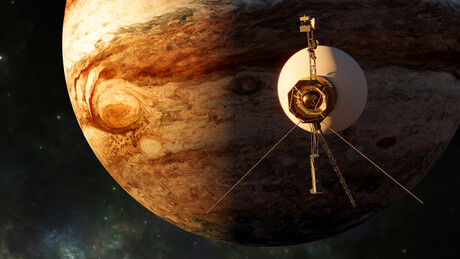
The process of thermoelectric power generation can produce electricity from nothing more than a temperature difference, without requiring any additional fuel. It’s the principle used by NASA to power deep-space probes, and is regarded as a promising source of sustainable energy.
While waste heat is plentiful, produced in vast amounts by industrial sites such as steel mills and semiconductor plants, the performance of thermoelectric generators in real-world operating environments has often fallen short of expectations. This is because efficiency depends not only on the material itself but also on the device structure. A wide range of factors — including the path of heat flow, the distribution of electrical resistance, contact losses, and load conditions — must work together in a highly coordinated way for the device to perform at its full potential.
Until recently, most thermoelectric generator designs have been developed largely through human intuition and repeated experimental testing. Now, however, South Korean researchers have developed a general design framework that enables computers to autonomously identify the optimal structure of thermoelectric generators.
The joint research team was led by Professor Jae Sung Son of the Department of Chemical Engineering at POSTECH (Pohang University of Science and Technology), in collaboration with Professor Hayoung Chung of the Department of Mechanical Engineering at UNIST (Ulsan National Institute of Science and Technology).
“This technology can derive optimal structures directly from input conditions without human trial and error, and its range of applications and impact could expand further through integration with AI,” Chung said.
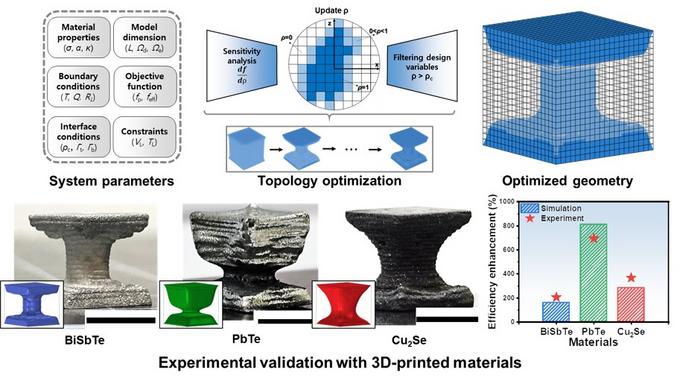
The researchers deployed topology optimisation, a computational design method that allows the computer to determine the most efficient three-dimensional geometry. Instead of starting from a preconceived shape, the computer evaluates the design conditions and generates structures that maximise efficiency while taking into account realistic operating parameters such as the thermal environment, material properties, contact resistance and electrical load.
The computer produced some surprising designs. While traditional thermoelectric generators are typically built in simple rectangular shapes because they are familiar and easy to fabricate, the computer came up with highly unconventional geometries, including I-shaped and asymmetric hourglass-shaped structures. These designs were found to enhance overall system efficiency by precisely controlling heat flow, increasing the temperature difference across the device and simultaneously minimising electrical resistance and contact-related losses.
Using 3D-printing technology, the team fabricated these optimised structures and experimentally evaluated their performance. The best-performing design achieved up to 8.2 times higher power-generation efficiency than a conventional rectangular generator. The experimental results also showed strong agreement with the computational predictions, confirming the validity of the framework.
The work points to a future in which wasted heat can be more effectively converted into useful electricity.
“This study is significant in that it moves beyond the conventional focus on discovering better materials and introduces a new pathway for improving performance through design-driven optimisation tailored to real thermal environments,” Son said.
The research has been published in Nature Communications (DOI 10.1038/s41467-026-69901-3).
Reducing electrical injuries in Australian workplaces
Monash research has highlighted a need for better electrical hazards training across a range of...
Electrical infrastructure for Sydney's expanding Metro
Fuji SMBE Macquarie has delivered Australian-made switchboards and power infrastructure to six...
Redesigning energy: can the grid adapt to significant change?
Whether you're an electrical worker, renewable energy proponent or data centre operator, this...