Putting next-gen solar to the test
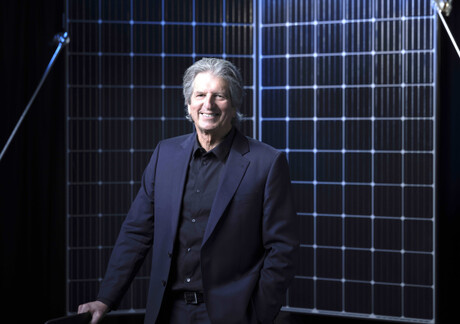
UNSW Sydney’s Scientia Professor Martin Green has spent more than five decades helping solar power become a cheap source of electricity. These days, the technology he developed underpins 90% of the world’s solar technology.
Now, he’s focusing on a new challenge in solar PV: testing the hardiness of perovskite solar modules. Often described as the ‘next generation’ of solar PV, perovskites are a class of crystalline materials that can be stacked on top of silicon solar cells to harvest more sunlight and push solar performance further.
However, while they perform impressively in the lab, perovskite modules are still too brittle to survive for decades in the real world.
Green is helping to establish an independent field-testing facility at UNSW’s Water Research Laboratory in Manly Vale, where perovskite solar modules will be subjected to durability testing under real-world conditions.
Green said that while these modules are already on the market, the expectation is that failed modules can simply be replaced as production scales and costs continue to fall.
“Silicon modules are routinely sold with warranties of 25 to 40 years,” he said.
“While the perovskite modules offer similar warranties, the likelihood of a module surviving for that long is very small.”
In the latest international solar cell efficiency tables, published recently in Joule, Green recorded a large-area silicon cell reaching 28.1% efficiency and a tiny perovskite cell — not a full-size commercial module — reaching 28.0%. This is the first time the best single-junction perovskite result has effectively matched the highest silicon result.
The same report includes a 35.2% efficiency result for a perovskite-on-silicon tandem cell.
In a solar cell, a few percentage points make a massive difference. Higher efficiency means more electricity from the same rooftop, and less land required for solar farms, with lower installation and infrastructure costs across entire energy systems.
The report’s latest numbers suggest solar is edging towards another technological shift — if the cells can last.
“Silicon, the workhorse of the global solar revolution, is now very efficient, but increasingly close to its limits,” Green said.
“And anyone who’s made a perovskite cell knows how unstable they are.”
A new frontier
Green believes perovskite-on-silicon tandem cells are the most likely large-scale commercial pathway for next-gen solar technology.
“All the silicon manufacturers have their own perovskite-on-silicon programs,” he said.
When his group first began setting records with silicon cells, Green insisted any claims be certified by recognised testing laboratories. That insistence on verification became a foundation of the modern solar industry and is the driving purpose of the independent field-testing facility Green is setting up alongside his former student, UNSW’s Dr Jessica Jiang.
The facility will be able to install up to 160 modules, catering to all manufacturers and generations of products.
Many perovskite manufacturers are part of China’s rapidly expanding solar industry — and Green’s former students.
One of China’s largest perovskite manufacturers, Microquanta, was started by two former students, while another former student is the founder of Suntech, Dr Zhengrong Shi. Shi’s commercialisation of modern solar technology has helped to propel China’s ascension as a global solar manufacturing heavyweight.
“Jessica has really good contacts within the Chinese industry, largely because they’re former students who now have important jobs in the industry,” Green said.
“She can WeChat them and the next day they’ll put a module in the mail.”
By comparing modules from different companies, the UNSW team hopes to identify which failure mechanisms are widespread and which are specific to individual designs.
“We’ll be able to provide an authoritative opinion about just how good the commercial ones are,” Green said.
“Once they fail in the field, we’ll find out why and provide that information back to the manufacturer,” he added.
“We really think we can push things along a bit.”
Clipsal organises recycling trial for electricians
The Qld pilot provides separate recycling bins for assembled electrical products, switch and...
Funding secured for 1.86 GWh Baranduda Electrical Energy Reserve
The technically advanced BESS will be located next to AusNet's Wodonga Terminal Station in...
Bringing microgrids to Far West NSW
A $3m NSW Govt initiative aims to strengthen energy resilience in the wake of the October 2024...