Protecting solar farms from bushfire smoke
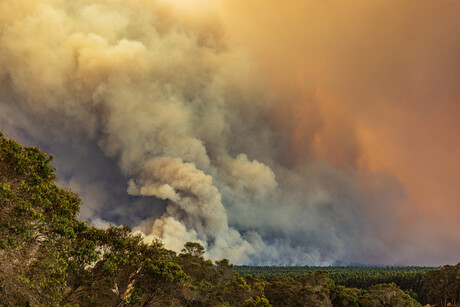
With extreme wildfires becoming more frequent globally, Australian researchers have looked into the impact of bushfire smoke on solar farms.
The UNSW Sydney team conducted a study examining the effects of two major Australian bushfires: the 2019–2020 Black Summer fires and Victoria’s 2009 Black Saturday fires. Using historical weather and satellite data, they modelled how smoke and airborne particles affected solar electricity generation and panel temperatures across south-eastern Australia.
Based on their findings, the researchers devised a set of recommendations for solar farm operators in bushfire-prone areas.
Dr Shukla Poddar, corresponding author on the study, said the research underlined the need to look beyond solar farms that are close to a fire and consider where smoke is likely to travel.
“We should start looking into things like trajectory modelling of the smoke and how long and far those smoke particles can be transported,” she said.
“Extreme bushfires are becoming more frequent and intense in several regions, including Australia, California and southern Europe. Their impacts are not confined to the areas where fires burn: smoke from California’s 2020 wildfires reached Europe, while smoke from Spain’s 2025 fires travelled as far as the UK and Northwestern Europe.
Far-reaching effects
Smoke and airborne particles can reduce the sunlight that reaches solar panels, lowering the amount of electricity they produce. Given that smoke from a bushfire can travel much farther than the immediate fire zone, relatively distant solar arrays can be affected.
During the Black Summer bushfires, for example, the researchers estimated that electricity generation fell by as much as 70% at locations within about 50 km of fire hotspots during several consecutive days. There were even losses for solar arrays more than 150 km from hotspots.
“Even at a radius of 150 km away from the hotspots, there was around 30% reduction on those bushfire days, or just after the bushfire days, because a lot of the wind had transported the smoke inland across New South Wales,” Poddar explained.
The effects varied with the severity of the fires and the weather. During the 2009 Black Saturday bushfires, the study estimated lower reductions of generated power of around 18% near fire hotspots and up to 10% in more distant regions.
These figures are modelled estimates rather than measurements from individual solar farms. The researchers were unable to separate smoke-related losses from other factors, such as electricity generation being deliberately limited when the grid did not need all the power available.
The need for ‘smoke forecasts’
The researchers recommend combining bushfire information, wind patterns and smoke-trajectory modelling to help predict which solar farms are likely to be affected.
While weather forecasts already help operators anticipate conditions such as high temperatures and strong winds, a similar system for smoke could give them advance warning that airborne particles are heading towards their facilities.
That warning could allow operators to plan inspections, schedule cleaning or adjust the position of panels before smoke arrives.
Poddar said historical wind patterns could also help operators understand which areas are more likely to be affected during bushfire conditions.
“If operators got an alert that their solar farm might be impacted, they could potentially adapt some mitigation strategies, such as adjusting the panel angle where appropriate or being aware that additional cleaning may be required,” she said.
Importance of panel maintenance
Smoke particles can settle on solar panels, reducing the sunlight reaching their surfaces.
If deposits accumulate unevenly, they may also create localised hot spots, where parts of a panel become much hotter than others. Over time, these hot spots can damage cells and reduce their performance. (As the researchers did not model this localised damage directly, further work is needed to establish how frequently it occurs during bushfires and how much generation it can cost.)
Poddar recommended more frequent cleaning when smoke is likely to affect a solar farm, alongside regular thermal inspections to identify unusually hot panels or electrical components. The paper also recommends better remote monitoring and electrical fault detection, allowing operators to identify temperature anomalies and quickly isolate affected parts of a system.
Managing grass and shrubs beneath panels, maintaining firebreaks and preparing bushfire management plans can help reduce the risk of fires starting or spreading within solar farms.
Adjusting panel angle
Many large solar farms use tracking systems that move panels to follow the Sun throughout the day. Poddar suggested operators could consider temporarily adjusting those angles during particularly hot periods, such as when bushfires are occurring, rather than always positioning panels for maximum sunlight.
The aim would be to reduce heat exposure and potentially help loose particles move off panel surfaces. However, such adjustments would involve a trade-off, since panels may produce less electricity while turned slightly away from the Sun.
Planning future solar farms
Beyond protecting existing facilities, the research could also help operators decide where to build future solar farms.
“This framework can be combined to understand the frequent bushfire hotspots and air trajectory pathways as a pre-feasibility assessment for site selection of new solar farms,” the researchers wrote.
The research can also be translated to locations outside Australia.
“Although this particular study is based on two extreme bushfires in Australia, the same method and analysis can be done for other parts of the world,” Poddar said.
The study has been published in the journal Solar Energy and can be read at DOI: 10.1016/j.solener.2026.115248.
Exploring the EV boom with Chau Le
Following a recent record that saw sales of electric vehicles outnumber petrol car sales for the...
The path to home electrification
It's crucial that consumers receive the right information at the right time, according to a...
New depths for subsea solar
Researchers have developed solar cells that can function 10 m underwater, potentially powering...