Data centres under pressure: the impact of heat in Australia
When data centre uptime is discussed, attention often turns to power redundancy, connectivity or cybersecurity. Yet one factor continues to operate in the background: thermal management, which is critical to avoiding thermal throttling, hardware degradation and unplanned downtime.
In Australia, this factor carries even greater weight.
Unlike colder regions where ambient air can support “free cooling” for large parts of the year, many Australian locations face consistently higher temperatures and prolonged summer heat. In cities like Brisbane and Perth, the number of hours where outside air can assist cooling is significantly lower than in cooler climates such as Melbourne or Canberra.
The rapid adoption of high-density computing, particularly CPUs, GPUs and AI accelerators, is pushing thermal output beyond what traditional air-based systems were designed to handle, driving a shift towards more advanced cooling approaches.
Why traditional cooling approaches are reaching their limits
Conventional air cooling has long been the backbone of data centre design. However, its effectiveness depends heavily on environmental conditions and airflow efficiency.
In hotter climates, air cooling becomes less efficient as the temperature difference between supply air and equipment decreases. This forces systems to consume more energy to achieve the same cooling effect, therefore increasing both operational costs and actual Power Usage Effectiveness (PUE).
Additionally, many Australian facilities rely on evaporative cooling systems, which introduce further considerations such as Water Usage Effectiveness (WUE) and long-term resource management.
As data centres continue to scale exponentially to support AI and high-performance computing, the physics-based limitations of traditional air-based cooling technologies are becoming more evident.
Designing for reliability in a changing environment
Addressing these challenges requires a shift from collating isolated cooling components to integrating a holistic thermal management strategy. The HYDAC Group owns several companies with thermal management technologies and delivers end-to-end solutions, owning the technology and manufacturing processes at the component level. As a vertically integrated provider, HYDAC ensures performance, reliability, and fluid cleanliness expertise.
Leveraging group-wide capabilities and knowhow, HYDAC is uniquely positioned to support this transition, delivering solutions across white and grey space as a holistic thermal management partner for data centres.
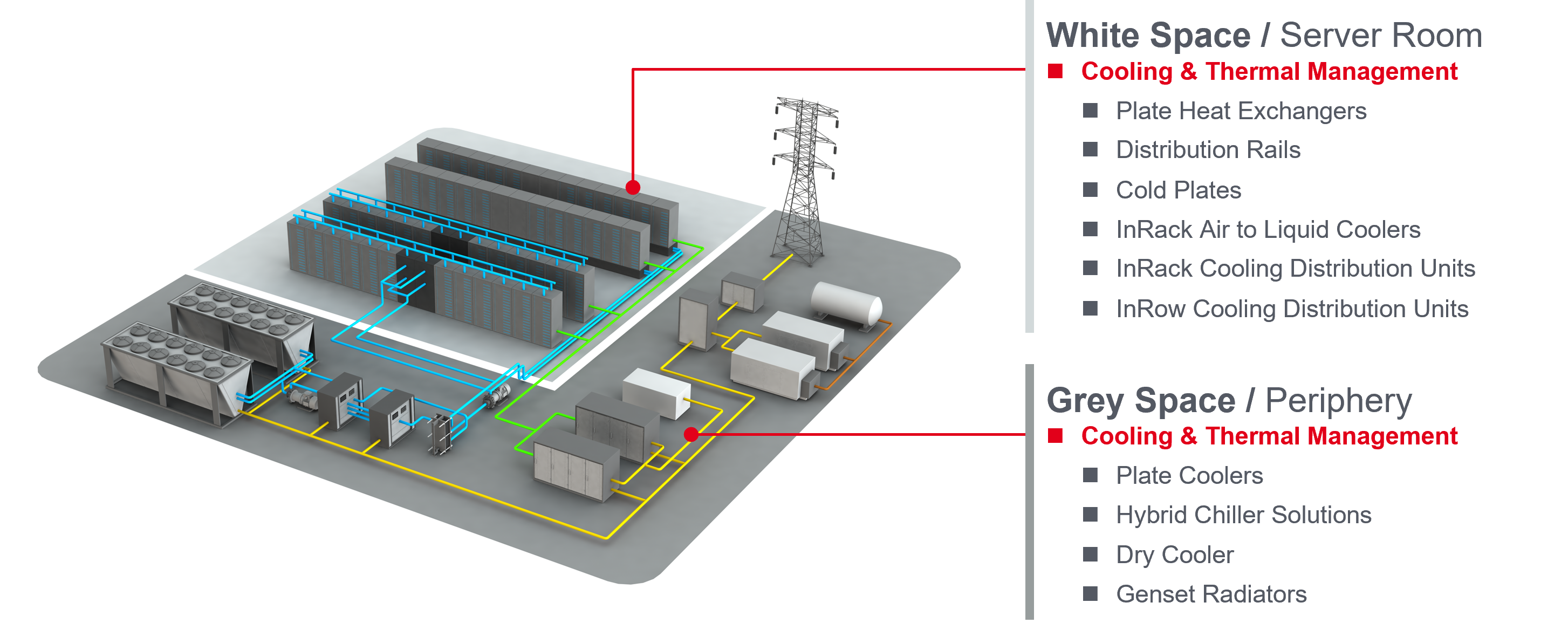
In the grey space, where supporting infrastructure such as generators and auxiliary systems operate, HYDAC delivers proven cooling technologies, including plate heat exchangers, hybrid chiller solutions, dry coolers and genset radiators, ensuring reliable and efficient thermal management.
In white space, HYDAC works in collaboration with COOLTECH to deliver advanced cooling systems tailored to high-density IT environments.
A central component of this approach is liquid cooling.
By using cold plates and water blocks to cool CPUs, GPUs and other high-dissipation components directly, liquid cooling significantly improves heat transfer efficiency compared to air. This enables stable performance even under extreme computational loads, while reducing overall energy consumption.
Complementing this, Coolant Distribution Units available in both liquid-to-liquid and air-to-liquid configurations, provide precise temperature control and scalable system architecture. These systems allow operators to adapt to increasing heat densities without redesigning entire facilities.
An all-in-one approach
For Australian data centres, thermal management is no longer a background consideration, it is a defining factor in operational resilience.
HYDAC offers a complete, all-in-one approach including thermal management, filtration and system integration expertise from a single partner. This unified capability helps data centres reduce complexity, improve efficiency and achieve more reliable, optimised performance.
HYDAC’s global expertise further supports this approach. As a member of the German Datacenter Association, HYDAC Germany contributes to industry best practices and ongoing innovation in data centre infrastructure.
For more information, please visit hydac.com.au.
Clean Fuel, Reliable Uptime: Diesel Monitoring in Data Centres
For a data centre operator, holding sufficient diesel onsite is only part of the resilience...
WBT's New OFDR Ducting Catalogue — Smarter Ducting Starts Here
Warren & Brown Technologies is proud to unveil the latest Optical Fibre Ducting Raceway...
Cool, Clean and Connected: An Integrated Approach to Data Centre Reliability
As data centres continue to scale in size, power density and complexity, reliability is no longer...