The often-overlooked factor in data centre uptime

Data centres have become a critical part of modern industrial and commercial infrastructure. From enterprise IT and financial systems to cloud platforms supporting process industries, these facilities are expected to operate continuously, often with very little tolerance for disruption. Yet in many designs, environmental monitoring still receives less attention than power redundancy or cybersecurity.
That’s a mistake.
Temperature and humidity control are not secondary concerns. They are fundamental to equipment reliability, energy performance and long-term operating costs. In practice, many data centre issues trace back not to dramatic failures, but to gradual environmental drift that went unnoticed for too long.
Heat and humidity: familiar risks, real consequences
Heat management is a growing challenge as rack densities increase. While overall room temperature may appear acceptable, localised hot spots at rack inlets or exhausts can push equipment beyond safe limits. These conditions rarely trigger immediate alarms but often show up later as reduced performance, unexplained resets or shortened hardware life.
Humidity creates a different kind of risk. High humidity raises the likelihood of condensation, corrosion and insulation breakdown. Low humidity increases the chance of electrostatic discharge, particularly during maintenance or equipment changes. Both conditions are well understood, yet still underestimated in day-to-day operations.
Energy efficiency also enters the equation. Overcooling remains a common response to uncertainty, particularly where environmental data is limited or unreliable. This approach may feel safe, but it drives up energy use and operating costs without necessarily improving reliability.
Standards are useful — measurement is essential
Guidelines such as those published by the American Society of Heating, Refrigerating and Air-Conditioning Engineers (ASHRAE) provide a solid framework for acceptable operating ranges. Typical targets place temperatures between roughly 18 and 27°C, with relative humidity maintained between 40% and 60%. These ranges are widely referenced, but they only matter if conditions are actually measured where equipment operates.
Room-level sensors alone are rarely sufficient. What matters is the air entering and leaving the racks, the performance of cooling delivery paths, and the stability of supporting spaces such as UPS and battery rooms.
Practical monitoring, not just more sensors
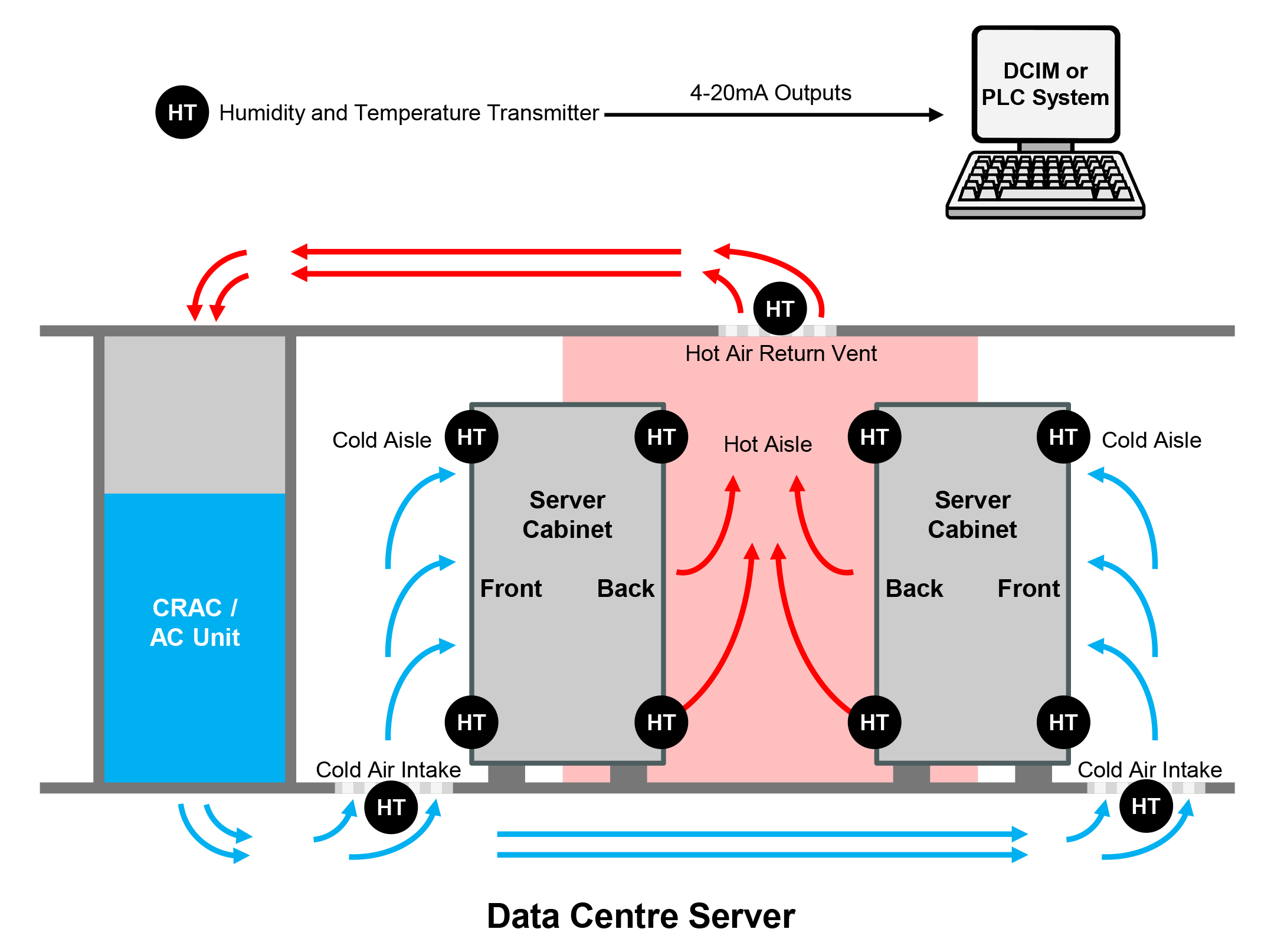
Effective environmental monitoring is less about the number of sensors and more about placement and integration. Rack inlets and outlets, hot and cold aisles, underfloor plenums and return air paths provide far more actionable data than a single average room reading.
Equally important is how that data is used. Temperature and humidity measurements should integrate into existing control, building management or DCIM systems using standard industrial signals and protocols. When environmental data is isolated, it becomes easy to ignore. When it is visible alongside power and airflow data, it supports better operational decisions.
Why continuous visibility pays off
Real-time environmental monitoring allows operators to spot developing issues before they affect uptime. It supports more precise cooling control, reduces unnecessary energy use and helps explain performance anomalies that might otherwise be attributed to IT hardware alone.
Over time, facilities with good environmental visibility tend to experience fewer unexplained failures, lower maintenance effort and more predictable operating conditions.
Conclusion
Environmental monitoring may not be the most visible part of a data centre, but it is one of the most influential. As facilities grow more complex and energy constraints tighten, relying on assumptions rather than measurement becomes increasingly risky. For engineers responsible for reliability and efficiency, precise temperature and humidity monitoring is no longer optional, it is part of doing the job properly.
Towards flexible data centres
Can data centres be transformed from static loads into dynamic, grid-aware assets?
Sustainable cloud in Australia: cutting carbon without cutting performance
How can we scale digital infrastructure without proportionally increasing its environmental impact?
Is data centre development outpacing the grid?
A new report from Wood Mackenzie identifies a concerning disparity between data centre...