Tackling aircon noise in data centres
As data centre power densities rise, cooling system design is expanding beyond capacity and energy efficiency to include another critical factor — noise.
The sounds produced by larger, more powerful cooling systems could become a serious issue for data centres — especially when they’re located in urban areas with strict noise regulations.
Seeking to address this problem, mission-critical air conditioning company STULZ teamed up with Merford, which specialises in noise control, doors and custom acoustic solutions, to establish a new benchmark for validated noise performance in data centre cooling. The companies conducted a unique acoustic test on a newly developed chiller for a project in Valeggio sul Mincio, Italy, which was conducted under realistic operating conditions using a fully validated measurement methodology.
The evaluated project had to comply with maximum night-time noise limits of 80.2 dBA; this required acoustic considerations to be incorporated into the early stages of equipment design.
“The challenge was not only to guarantee efficient cooling but to comply with extremely strict noise limits,” said Davide Mazzi, head of the STULZ Application Team at STULZ SpA.
“The installation is located on a rooftop in a densely built urban environment. Our task was to deliver the required performance without disturbing the surroundings and without compromising the operational reliability of the data centre.”
Since comprehensive acoustic validation of large cooling equipment is rarely conducted, STULZ and Merford developed an integrated noise attenuation system designed specifically for this chiller configuration. The acoustic measurements were conducted according to EN ISO 9614-2:1997, which determines sound power levels using sound intensity measurements.
Prior to testing, a detailed environmental analysis was carried out. Using a three-dimensional acoustic model in SoundPLAN, which is specialised software for sound propagation calculations based on ISO 9613-2, the team optimised the test configuration.
Background noise levels had to be at least 10 dB below the sound emitted by the chiller itself. A measurement location was established at the production site, with supporting equipment such as transformers, boilers and pump skids deliberately positioned to ensure their operation would not interfere with the measurement process.
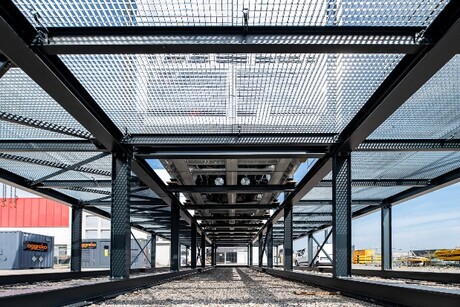
The team trialled two different noise attenuation concepts, both comprising steel frame structures surrounding the chiller with integrated acoustic attenuators to mitigate both airborne and structure-borne noise. The first configuration served as a baseline to deliver broad spectrum noise reduction, while the second incorporated additional acoustic optimisation and enhanced source control measures to further reduce total sound power levels. While the second configuration introduced additional weight and structural complexity, it led to demonstrably greater noise reduction.
To verify the effectiveness of the system, engineers measured the chiller’s sound power level both with and without the attenuation structure in place. This comparative approach enabled the team to objectively quantify the noise reduction achieved and confirm regulatory compliance.
“We were delighted to find that the chiller equipped with the developed attenuation system successfully met the stringent noise requirements,” Mazzi concluded.
“This project demonstrates that data centre cooling and acoustic compliance can be achieved simultaneously when engineering, acoustic design and validation are approached as an integrated process. As data centres continue to expand into urban environments, such integrated approaches are likely to become essential for balancing performance, sustainability and community impact.”
Towards flexible data centres
Can data centres be transformed from static loads into dynamic, grid-aware assets?
Sustainable cloud in Australia: cutting carbon without cutting performance
How can we scale digital infrastructure without proportionally increasing its environmental impact?
Is data centre development outpacing the grid?
A new report from Wood Mackenzie identifies a concerning disparity between data centre...