Sustainable cloud in Australia: cutting carbon without cutting performance
By Thiru Prakassh, Regional Data Centre Lead APAC, OVHcloud
Monday, 20 July, 2026

Cloud adoption is accelerating. AI workloads are expanding. Data volumes are rising at an unprecedented rate.
Australia’s digital economy is entering a new phase of growth, and organisations are generating and processing more data than ever before. But alongside this progress sits a growing challenge: how to scale digital infrastructure without proportionally increasing its environmental impact.
The reality is that data centres carry a significant energy and resource footprint. Cooling systems alone account for a substantial share of energy consumption, with traditional air‑cooled environments relying heavily on electricity and large volumes of water to maintain stable operating temperatures. As scrutiny around resource use intensifies, this has become a critical issue for industry and government alike, with organisations increasingly prioritising transparency and factoring in sustainability to their procurement decisions.
Transparency as a baseline
Transparency is becoming foundational to the cloud conversation. As organisations deepen their reliance on cloud infrastructure, they are also being asked to take greater responsibility for the environmental cost of their operations. Historically, however, visibility into energy use, water consumption and full lifecycle emissions has been limited.
Without consistent and verifiable data, it is difficult for businesses to make informed decisions or to meet growing regulatory and stakeholder expectations.
Sustainability as a procurement driver
Sustainability is also rapidly becoming a core procurement requirement for Australian enterprises. Environmental considerations are no longer isolated to corporate responsibility teams. They are now embedded in vendor selection, risk management and long-term strategy.
As regulatory frameworks expand and emissions disclosure becomes more rigorous, organisations are expected to demonstrate not only their own commitments, but also the performance of their technology partners. This extends sustainability accountability across the entire supply chain.
Engineering efficiency into infrastructure
The role of infrastructure design is central to this transition. Innovation in data centre engineering is demonstrating that environmental impact can be reduced without compromising performance.
Cooling technologies are a clear example. Moving beyond conventional air cooling, newer approaches use direct water cooling to manage heat at the component level.
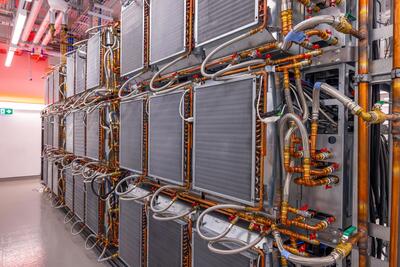
By circulating cooled water through systems that directly connect to high‑intensity components such as CPUs and GPUs, these designs remove heat more efficiently and reduce reliance on energy‑intensive fans. Complementary systems, including heat exchangers and dry coolers, enable heat to be transferred and dissipated outside of the data centre environment, while adapting in real time to temperature conditions.
The impact of these approaches is measurable. Some modern data centre environments are achieving power usage effectiveness levels around 1.24, compared to a much higher industry average. Water consumption is also more controlled, with systems designed to use minimal volumes under standard conditions and only increase usage during periods of higher temperature. This demonstrates that efficiency gains can be engineered directly into infrastructure.
The role of accountability and measurement
Innovation alone is not sufficient. Visibility and accountability must sit alongside it.
Tools that enable organisations to track and understand the environmental impact of their cloud usage are therefore becoming increasingly important.
With more advanced measurement capabilities, businesses can assess emissions across the full lifecycle of infrastructure including manufacturing and operation, with visibility across Scope 1, 2 and 3 emissions. This enables alignment with recognised standards and supports more accurate reporting.
As organisations evaluate cloud providers, the questions being asked are becoming more rigorous:
- What are the provider’s energy efficiency metrics, including power usage and water usage effectiveness?
- How is infrastructure powered, and what visibility exists across emissions?
- Is reporting available across Scopes 1, 2 and 3?
- How is hardware lifecycle managed, including reuse and reconditioning?
- Are sustainability claims supported by transparent, verifiable data?
The path forward
The answers to these questions will define the next stage of Australia’s digital growth. As demand for cloud infrastructure continues to rise, the industry must ensure that performance gains are not achieved at the expense of environmental impact.
The path forward is clear. It requires continued innovation in infrastructure design, greater transparency in reporting, and stronger alignment between customer expectations and provider capabilities. Just as importantly, it requires recognising that sustainability is no longer a differentiator but the baseline — embedded in how services are designed, delivered and evaluated.
Sustainable practices are now inseparable from operational resilience and efficiency. Lower energy consumption reduces exposure to cost volatility, while improved resource efficiency supports long-term scalability. In this context, sustainability and performance are not competing priorities but intrinsically linked drivers of future success.
If these elements come together, Australia can scale its digital economy with confidence — delivering the performance required for growth while upholding the environmental responsibility increasingly expected by customers, stakeholders and society at large.

Towards flexible data centres
Can data centres be transformed from static loads into dynamic, grid-aware assets?
Is data centre development outpacing the grid?
A new report from Wood Mackenzie identifies a concerning disparity between data centre...
Making the case for sustainable data centres
The next generation of data centres will be defined by circular thinking that prioritises...