Creating future-proof dwellings for a harsh climate
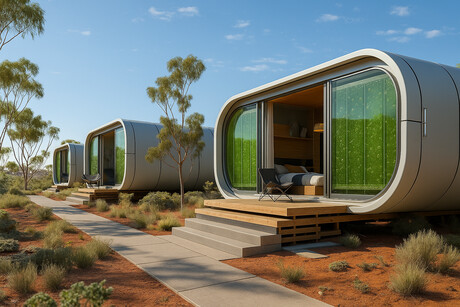
What makes a smart, comfortable, sustainable living space in an era of extreme heat? Australian research has a few ideas.
In Tennant Creek, about 500 kilometres north of Alice Springs, CSIRO is collaborating with Aboriginal non-profit consultancy Wilya Janta on the building of a pilot house.
Wilya Janta means “standing strong”. It has been set up by Indigenous leaders to directly involve the local community in the development of culturally sensitive housing that’s specifically designed for them. Given that temperatures here can range from 12 degrees in winter to over 40 in summer, CSIRO is providing advice on energy and thermal efficiency for the fully off-grid house.
The science body’s modelling and design advice will help to ensure that the house remains cool in summer without air conditioning for as long as possible, as well as minimising the power needed if air conditioning is used. With a 7-star energy rating, the house is intended to provide thermal comfort and lower energy costs equivalent to those expected in new homes in major capital cities.1
“One of the main goals is we need to make sure elderly people aren’t dying prematurely from extremes of temperature, and that medicine can be stored,” said Anthony Wright, CSIRO’s Energy Performance group leader.
Original Power, a First Nations-led not-for-profit, supplied, designed and installed the solar and battery system for the project alongside PAB Electrical from Alice Springs.
Once the model in Tennant Creek has proven viable, Wilya Janta intends to seek formal partnerships with the NT Government and Community Housing providers to support broad adoption of the model for delivery of community-directed housing.2
This emphasis on sustainability, energy efficiency and sensitivity to local conditions is a theme that’s driving some innovative and surprising developments in Australian building technology. Take, for example, the work of Amin Mirabbasi, a PhD student at Murdoch University. At the Algae Innovation Hub he set up, Mirabbasi has spent three years designing microalgae-filled photobioreactors, which can be incorporated into a variety of structures such as houses, apartments, mining dongas and urban designs.
Mirabbasi said WA’s climate offers ideal growing conditions for microalgae.
“Compared with colder European and southern Australian climates, Perth presents negligible freezing risk and high solar availability, which supports microalgae cultivation; however, overheating control is essential,” he said.
The environmental benefits of microalgae include carbon capture and the reduction of greenhouse gas emissions. Microalgae have been reported to exhibit CO2 fixation efficiencies 10–50 times higher than terrestrial plants, together with rapid growth rates and high biomass productivity.
Mirabbasi also believes the ability of microalgae to absorb heat could be a game changer for sustainable architecture. “Because the microalgae culture (water medium) absorbs heat and filters solar radiation, these photobioreactors can significantly reduce indoor overheating, as our tests showed,” he said.
“In WA’s climate, that means less reliance on air conditioning during peak hours, which translates into real energy and cost savings.”
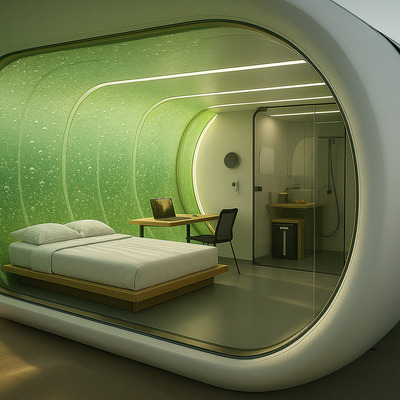
One of Mirabbasi’s research projects has been the design of prefabricated mining accommodation units that are purpose-built for harsh rural environments. The microalgae photobioreactors installed on these mining dongas act as a passive solar control system, shading the building and absorbing heat, while simultaneously generating oxygen and purifying the air.
Mirabbasi has also incorporated microalgae into designs for the urban environment, including bus stops, shelters, garages and an ‘Urban Algae Tree’, which provides shade from the sun by absorbing heat. It also captures rainwater and operates self-sufficiently using its own harvested solar energy.
Other designs feature tubular photobioreactors positioned along walkways, building exteriors and shopping districts, which can be fitted with LED lighting to illuminate the green culture at night — creating enticing public spaces.
“The beauty of these biodesigns is they combine science and nature in a way people can see and feel. Watching the microalgae grow, bubble and respond to light creates a biophilic experience that draws people in, connects them to nature and quietly reinforces sustainability awareness in everyday spaces,” Mirabbasi said.
Now nearing the end of his PhD, Mirabbasi intends to test his ideas in the real world.
“For me, this research isn’t about staying on the drawing board. It’s about turning ideas into tangible outcomes — designs that can be built, tested and implemented in real settings, where they can genuinely make a difference,” he said.
1. Edwards, A. (2025) Better by design: Culture at the heart of remote housing in the Northern Territory. www.csiro.au/en/news/All/Articles/2025/June/Aboriginal-Housing
2. www.wilyajanta.org/our-work
New depths for subsea solar
Researchers have developed solar cells that can function 10 m underwater, potentially powering...
Lightweight e-bike supports ocean health
In response to a growing demand for low-maintenance e-mobility in cities, igus has developed an...
Trial supports stranded EV drivers
RACV is testing out a new mobile DC fast charger as part of its Emergency Roadside Assistance...