Kmart hits 100% renewable electricity target

Kmart Group has hit a target of 100% renewable electricity across all of its operations — part of a commitment to achieve net zero Scope 1 and 2 emissions by 2030.
The retailer announced this achievement at the Kmart Distribution Centre in Jandakot, WA, alongside the Assistant Minister for Climate Change and Energy, Josh Wilson.
Currently, Kmart Group’s total electricity use across the 448 stores, 10 distribution centres, and 12 national and international offices that encompass Kmart and Target is covered by onsite renewables or offsite agreements from renewable sources.
For onsite power, the company uses solar photovoltaic systems, including three new installations in FY2025. Offsite, it deploys power purchase agreements with generation assets including New England Solar Farm (NSW), Numurkah Solar Farm (Vic), Tailem Bend 2 Solar Farm (SA) and Western Downs Green Power Hub (Qld).
In instances where energy is supplied by its landlords, Kmart Group surrenders unbundled large-scale generation certificates to match the energy consumed.
Since committing to 100% renewable electricity, the company has also achieved a 4.9% reduction in total electricity use since 2021, while adding 10 stores across Australia and New Zealand.1 The retailer said it had achieved its energy reduction through measures including efficient lighting design and energy-efficient HVAC in stores.
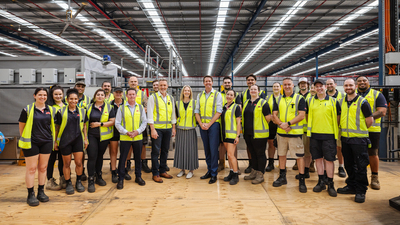
“With a significant footprint of stores across Australia, matching 100% of the energy needs of our stores, distribution centres and offices with renewable electricity marks an important step towards our commitment to reach net zero emissions by 2030,” said Kmart Group’s Chief Corporate Affairs and Sustainability Officer, Alexandra Staley.
Wilson said that Kmart was demonstrating how Australian businesses are stepping up to help deliver the nation’s clean energy goals.
“Kmart is showing that the pursuit of greater sustainability can and should be undertaken across the board, and that large organisations have the scale and resources to keep doing more,” he said.
1. Wesfarmers Sustainability Databook FY21 and FY25
FY21 energy consumption = 1.68 petajoules
FY25 energy consumption = 1.35 petajoules
New roadmap to expand EV charging in Australia
The Electric Vehicle Council is developing a national roadmap to help plan the charging...
Work to begin on major Qld BESS
Enerven has been contracted to deliver the 400 MW/1600 MWh Teebar Battery Energy Storage System,...
Funding secured for 1.86 GWh Baranduda Electrical Energy Reserve
The technically advanced BESS will be located next to AusNet's Wodonga Terminal Station in...